What Is SEO and Why Does Every Albuquerque Business Need It?
You’ve almost certainly been told your business “needs SEO.” Maybe more than once. But if you’ve never gotten a clear, jargon-free explanation of what SEO actually is, why it matters, and how it works — you’re not alone. Most of the marketing world does a terrible job of explaining the fundamentals. This article fixes that.
SEO — Search Engine Optimization — is the practice of making your website more visible in Google’s search results for the terms your customers are already searching. Done correctly, it’s one of the most powerful and cost-efficient marketing investments a local Albuquerque business can make. This is part of our complete guide to web design services in Albuquerque.
Why Google Is the Most Important Referral Source Your Business Has
Think about how your own customers find you. Some are referrals. Some see a sign. Some find you through social media. But for most local service businesses in Albuquerque, the single largest untapped source of new customers is Google search — people who are actively looking for exactly what you offer, right now, in your geographic area.
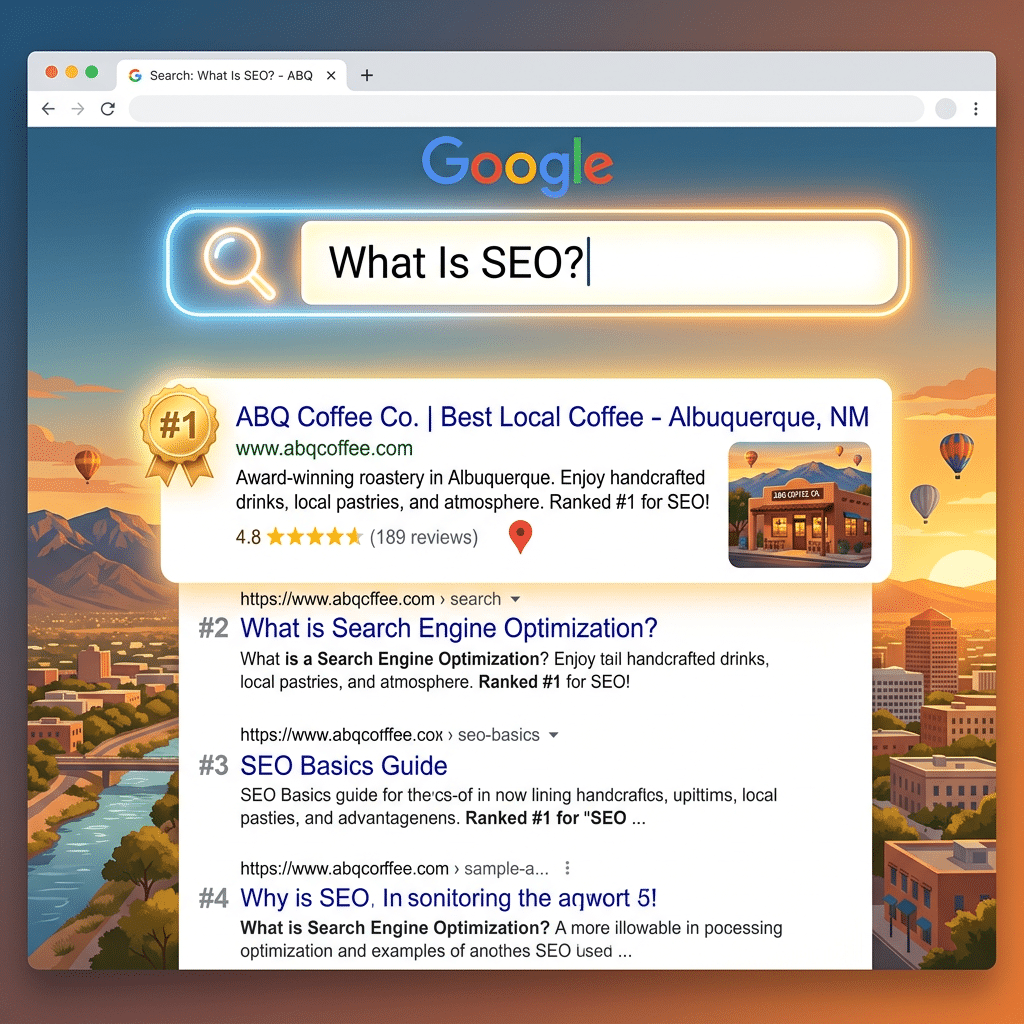
The difference between appearing on page one of Google and page two isn’t minor. The first result on Google gets approximately 27% of all clicks. The second result gets about 15%. By the time you get to page two, you’re capturing less than 1% of searchers. Most people never scroll past the first few results — and almost nobody goes to page two.
If your business isn’t on page one for the searches your customers are making, you’re essentially invisible to the largest pool of ready-to-buy customers in your market. That’s the problem SEO solves.
How Google Decides Who Ranks
Google’s ranking algorithm evaluates hundreds of signals to determine which websites deserve to appear for a given search. While the full algorithm is proprietary and constantly evolving, the major categories Google has confirmed are:
- Relevance: Does your page actually address what the searcher is looking for? Does the content match the intent behind the query?
- Authority: Do other reputable websites link to yours? How established is your domain over time? Are you mentioned across the web in ways that signal credibility?
- Experience: Is your site fast, mobile-friendly, and easy to navigate? Do visitors stay and engage with the content, or do they immediately leave?
- Trust: Is your business information consistent across the internet? Are you verified on Google? Do you have genuine reviews? Is your site secure?
Google’s broader framework for evaluating content quality is called E-E-A-T: Experience, Expertise, Authoritativeness, and Trustworthiness. It’s designed to surface content from real businesses with genuine knowledge and a real reputation — and to filter out thin, generic, low-effort content that doesn’t actually serve the searcher.
The Two Types of Local Search Results
For local businesses, Google surfaces two distinct types of results that require different optimization strategies:
- The Local Map Pack: The three business listings with the embedded map that appear at the very top of local search results. These are driven primarily by your Google Business Profile, your reviews, your NAP (Name, Address, Phone) consistency across the web, and your proximity to the searcher. If someone searches “web designer near me” in Albuquerque, the map pack is often the first thing they see.
- Organic “Blue Link” Results: The traditional ranked website listings below the map pack, driven by your on-page content, backlinks, domain authority, and technical SEO. These reward consistent, long-term investment in content and link building.
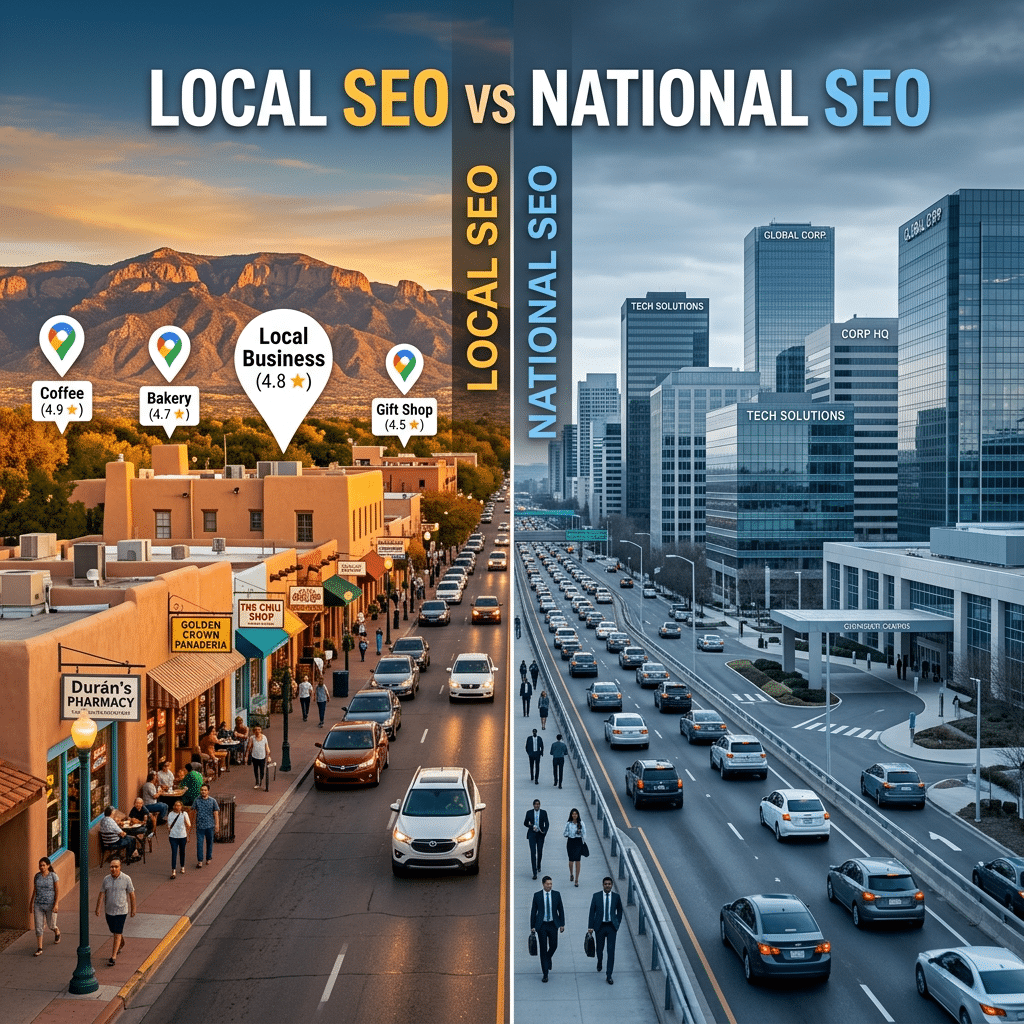
A complete SEO strategy wins both. The map pack drives high-intent local traffic in the short term. Organic rankings build compounding authority that grows more valuable over time. We cover the strategic choice between local and national targeting in our article on Local SEO vs National SEO for New Mexico Businesses.
What SEO Actually Involves — The Main Components
Keyword Research
Before you can optimize for search, you need to know what your customers are actually searching for. Keyword research identifies the specific phrases — “web design Albuquerque,” “Albuquerque marketing agency,” “affordable website design New Mexico” — that real people are typing into Google. It also identifies the search volume (how many people search each term monthly), the competition level (how hard it is to rank), and the intent behind each search (are they researching, comparing, or ready to buy?).
Keywords are the foundation. Every piece of content you create should be built around a keyword that real people search for. Publishing content that nobody searches for is the most common content marketing mistake — and it’s completely avoidable with proper keyword research.
On-Page SEO
On-page SEO is the optimization of individual pages to rank for their target keywords. It includes: writing a compelling, keyword-containing meta title (the blue link text in search results); crafting a meta description that earns clicks; structuring the page with proper H1, H2, and H3 headings; ensuring the target keyword appears naturally in the body content; optimizing image alt text; and building internal links to and from related pages across the site.
Technical SEO
Technical SEO ensures that Google can actually find, crawl, and index your pages correctly. Issues like pages accidentally set to “noindex,” missing XML sitemaps, slow page load times, broken internal links, and duplicate content without canonical tags can make an otherwise well-written site nearly invisible to Google. A technical SEO audit identifies and resolves these underlying issues before any content work is done.
Content Strategy
Content is how you build topical authority over time. Every useful article, every well-structured service page, every FAQ that answers a question your customers actually ask — these are opportunities to rank for additional searches and demonstrate to Google that your site is a comprehensive, trustworthy resource in your field. The pillar-and-cluster content model — where a comprehensive guide links to and from a series of supporting articles — is one of the most effective frameworks for building authority in a specific topic area.
Link Building
Backlinks — links from other websites pointing to yours — remain one of Google’s strongest ranking signals. They function as editorial votes of confidence. A link from the Albuquerque Chamber of Commerce, a local news publication, or a complementary business signals to Google that your site is legitimate and worth ranking. Building a baseline of local citations (Yelp, BBB, Google Business Profile, Apple Maps) is the starting point; earning genuine editorial backlinks through quality content and local relationships is the long-term strategy.
Why SEO Compounds Over Time
Unlike paid advertising — which stops delivering the moment you stop paying — organic SEO is a compounding investment. Rankings earned through consistent content creation and link building continue delivering traffic months and years after the work was done. A well-optimized page can rank and generate leads for years without additional investment beyond maintenance.
This is why businesses that start their SEO investment early gain an advantage that’s genuinely hard for later competitors to overcome. The domain authority, the content library, the backlink profile — these take time to build, and they become a meaningful competitive moat once established.
If your business isn’t showing up for the searches that matter, start with Why Your Albuquerque Business Isn’t Showing Up on Google to diagnose the specific reasons — then start a conversation with us and let’s build your strategy from the ground up.