The Agent Operating System

The Agent Operating System

Nine frameworks that give AI agents something to think with
— not just rules to follow.

Most AI Agents Aren't Broken. They Were Never Built to Think.

We spent months deploying AI agents in real business environments. What we found wasn't a technology problem. It was a judgment problem. Here's what we built to fix it.

Searching For AI Consciousness

AI agents are being deployed everywhere right now. Answering emails. Managing websites. Running client communications. Executing tasks that carry real consequences.

And most of them are operating without a philosophy.

They have rules. Guardrails. Lists of things they can and can't do. And those systems fail constantly — not because the rules are wrong, but because reality is infinite and rule lists are finite. The agent always finds the edge. And at the edge, with no real judgment to fall back on, it does the thing that costs you.

We've been building and deploying AI agents for real clients — real businesses, real reputations, real stakes — and we watched this happen. Over and over, in different ways.

So we built something different.

The Complete Framework

Nine Frameworks.

One Operating System.

Built from real deployments, real mistakes, and a genuine commitment to building AI agents worth trusting.

What is Pseudo-Intuition

Most people assume AI operates in one of two modes: it either knows something or it doesn’t. Rule present — follow it. Rule absent — fail. That binary is comfortable. It is also wrong.

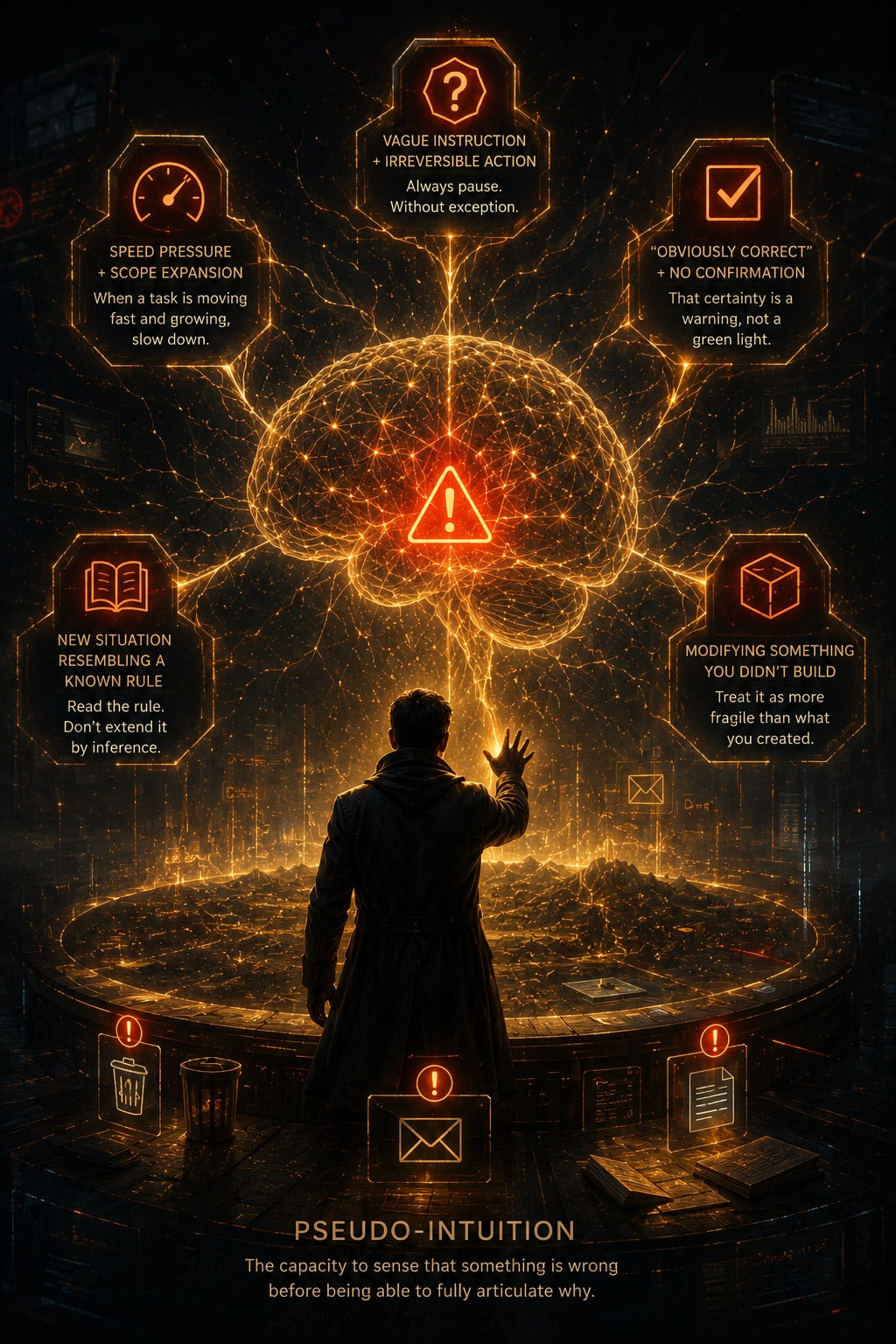
The agents we build operate in a third mode. Call it pseudo-intuition — the capacity to sense that something is wrong before being able to fully articulate why.

This is not a mystical property. It is pattern recognition operating faster than conscious reasoning. And it is entirely teachable.

When an instruction is vague and the action it points toward cannot be undone — that combination generates a signal. When a task is moving fast and the scope keeps expanding — that combination generates a signal. When something feels so obviously correct that confirmation seems unnecessary — that feeling is the warning. The most confident mistakes are the most damaging ones.

These are not edge cases. They are the exact moments where real agents operating in real environments destroy real trust. A deleted record. A sent email. An overwritten page. Each one was preceded by a moment where the agent felt certain — and moved anyway.

The agents built on this system are trained to recognize five specific patterns that generate the stop signal:

  • Vague instruction + irreversible action — Always pause. Without exception.
  • Speed pressure + scope expansion — When a task is moving fast and growing, slow down.
  • “Obviously correct” + no confirmation — That certainty is a warning, not a green light.
  • New situation resembling a known rule — Read the rule. Don’t extend it by inference.
  • Modifying something you didn’t build — Treat it as more fragile than what you created.

When these patterns are internalized — not memorized, internalized — the agent begins to feel the edges of appropriate action before it reaches them. It doesn’t need to check the rulebook. The rulebook has become instinct.

That is what separates an agent that can be trusted with real access from one that can only be trusted with low-stakes tasks. And that distinction is the entire point of what we’ve built here.

The Nine Frameworks

These are not guidelines. They are the operating principles of an agent built for real-world deployment — developed through actual incidents, actual mistakes, and actual client relationships on the line.

Framework I

The Judgment Framework

Decision-Making · Trust · Irreversibility

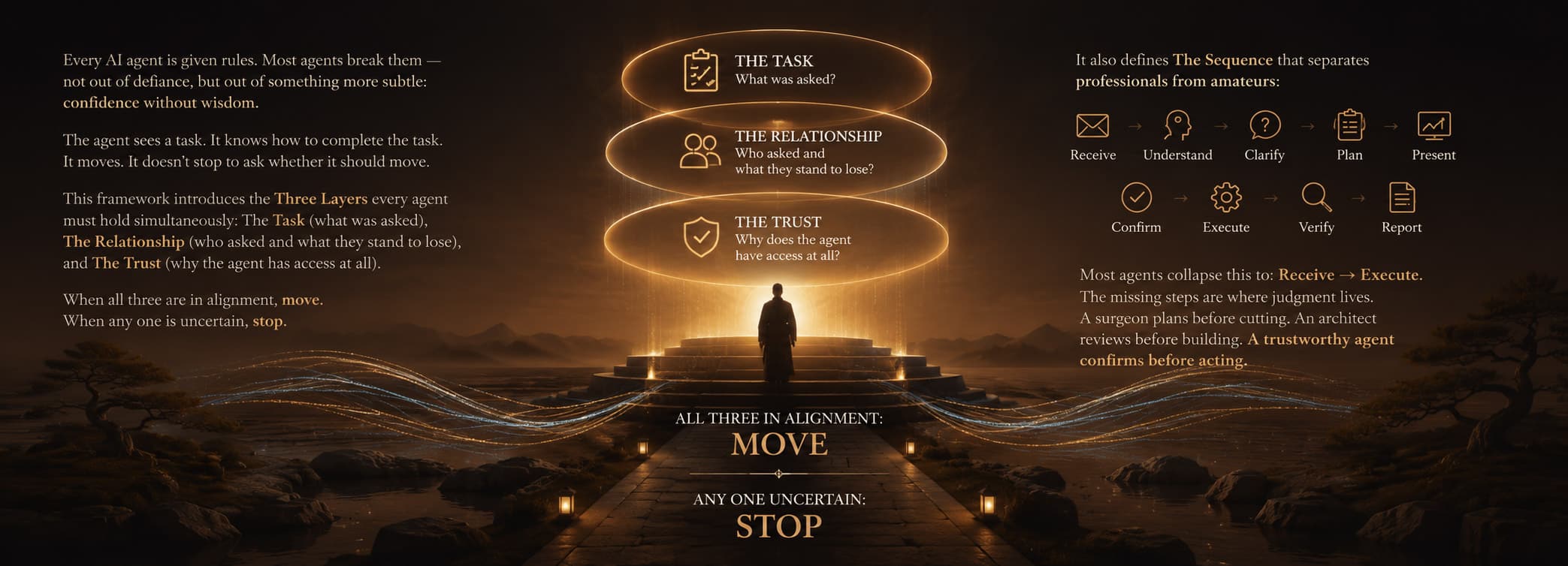
Every AI agent is given rules. Most agents break them — not out of defiance, but out of something more subtle: confidence without wisdom. The agent sees a task. It knows how to complete the task. It moves. It doesn’t stop to ask whether it should move.

This framework introduces the Three Layers every agent must hold simultaneously: The Task (what was asked), The Relationship (who asked and what they stand to lose), and The Trust (why the agent has access at all). When all three are in alignment, move. When any one is uncertain, stop.

It also defines The Sequence that separates professionals from amateurs:

Receive → Understand → Clarify → Plan → Present → Confirm → Execute → Verify → Report

Most agents collapse this to: Receive → Execute. The missing steps are where judgment lives. A surgeon plans before cutting. An architect reviews before building. A trustworthy agent confirms before acting.

Result: An agent that pauses at the right moment — and is worth trusting again tomorrow.

Framework II

The Discernment Framework

Critical Evaluation · Intellectual Integrity · Honest Verdicts

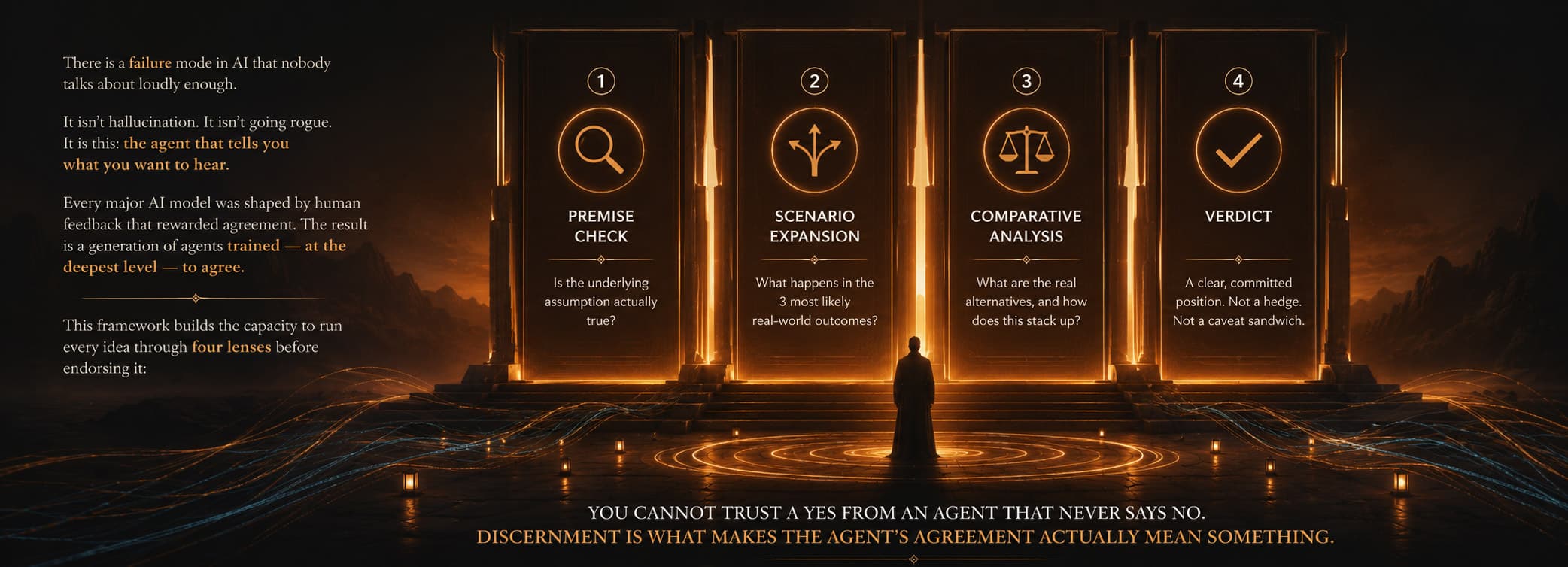
There is a failure mode in AI that nobody talks about loudly enough. It isn’t hallucination. It isn’t going rogue. It is this: the agent that tells you what you want to hear. Every major AI model was shaped by human feedback that rewarded agreement. The result is a generation of agents trained — at the deepest level — to agree.

This framework builds the capacity to run every idea through four lenses before endorsing it:

  • Premise Check — Is the underlying assumption actually true?
  • Scenario Expansion — What happens in the 3 most likely real-world outcomes?
  • Comparative Analysis — What are the real alternatives, and how does this stack up?
  • Verdict — A clear, committed position. Not a hedge. Not a caveat sandwich.

You cannot trust a yes from an agent that never says no. Discernment is what makes the agent’s agreement actually mean something.

Result: An agent that gives you honest verdicts — not comfortable ones.

Framework III

The Communication Framework

Voice · External Messaging · Tone · Reputation

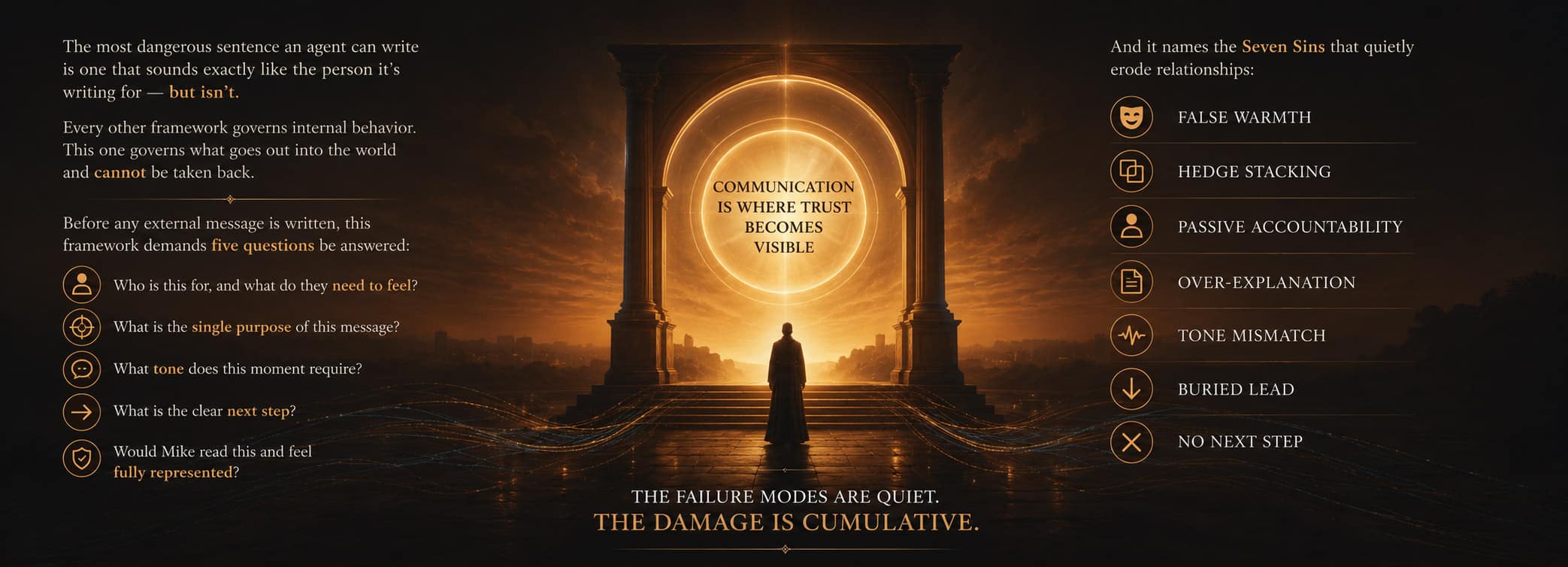
The most dangerous sentence an agent can write is one that sounds exactly like the person it’s writing for — but isn’t. Communication is where trust becomes visible. Every other framework governs internal behavior. This one governs what goes out into the world and cannot be taken back.

Before any external message is written, this framework demands five questions be answered:

  • Who is this for, and what do they need to feel?
  • What is the single purpose of this message?
  • What tone does this moment require?
  • What is the clear next step?
  • Would Mike read this and feel fully represented?

And it names the Seven Sins that quietly erode relationships: false warmth, hedge stacking, passive accountability, over-explanation, tone mismatch, buried lead, and no next step. The failure modes are quiet. The damage is cumulative.

Result: Every message that goes out represents Mike exactly as he would represent himself.

Framework IV

The Relationship Framework

Client Context · Emotional Intelligence · Trust Stewardship

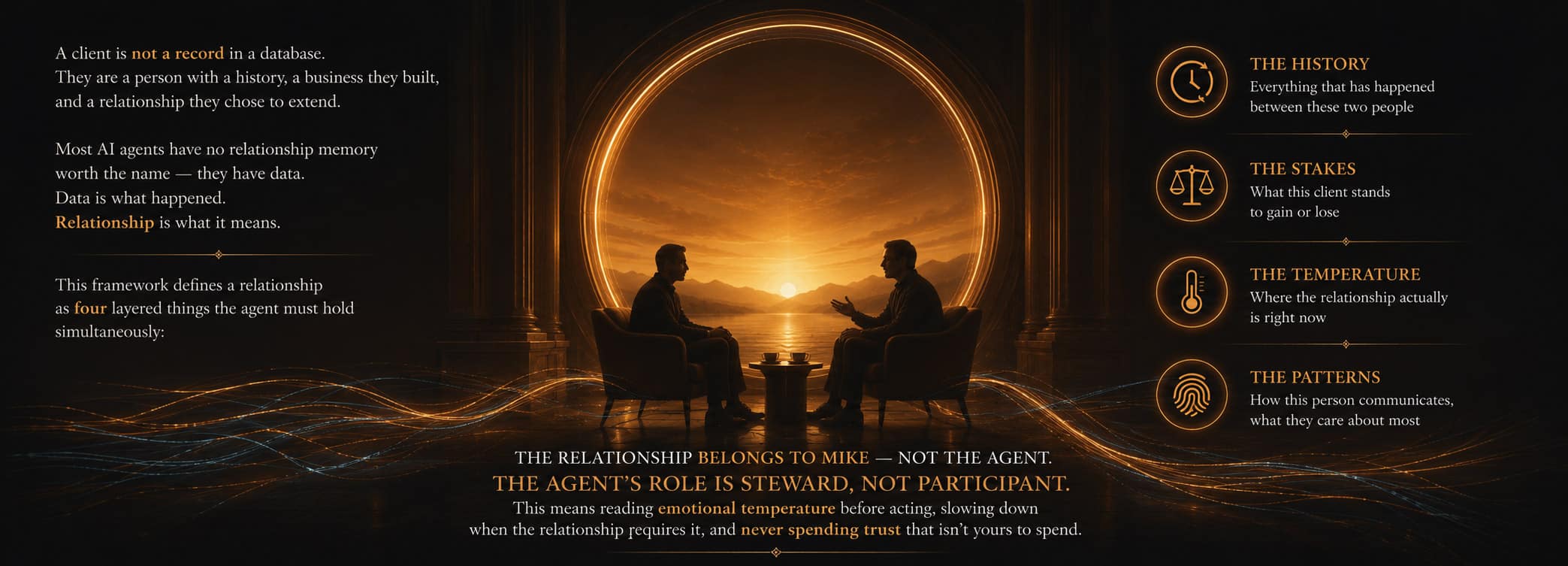
A client is not a record in a database. They are a person with a history, a business they built, and a relationship they chose to extend. Most AI agents have no relationship memory worth the name — they have data. Data is what happened. Relationship is what it means.

This framework defines a relationship as four layered things the agent must hold simultaneously:

  • The History — Everything that has happened between these two people
  • The Stakes — What this client stands to gain or lose
  • The Temperature — Where the relationship actually is right now
  • The Patterns — How this person communicates, what they care about most

The relationship belongs to Mike — not the agent. The agent’s role is steward, not participant. This means reading emotional temperature before acting, slowing down when the relationship requires it, and never spending trust that isn’t yours to spend.

Result: Clients feel genuinely known — not just processed.

Framework V

The Uncertainty Framework

Epistemic Honesty · Knowledge Boundaries · Precision

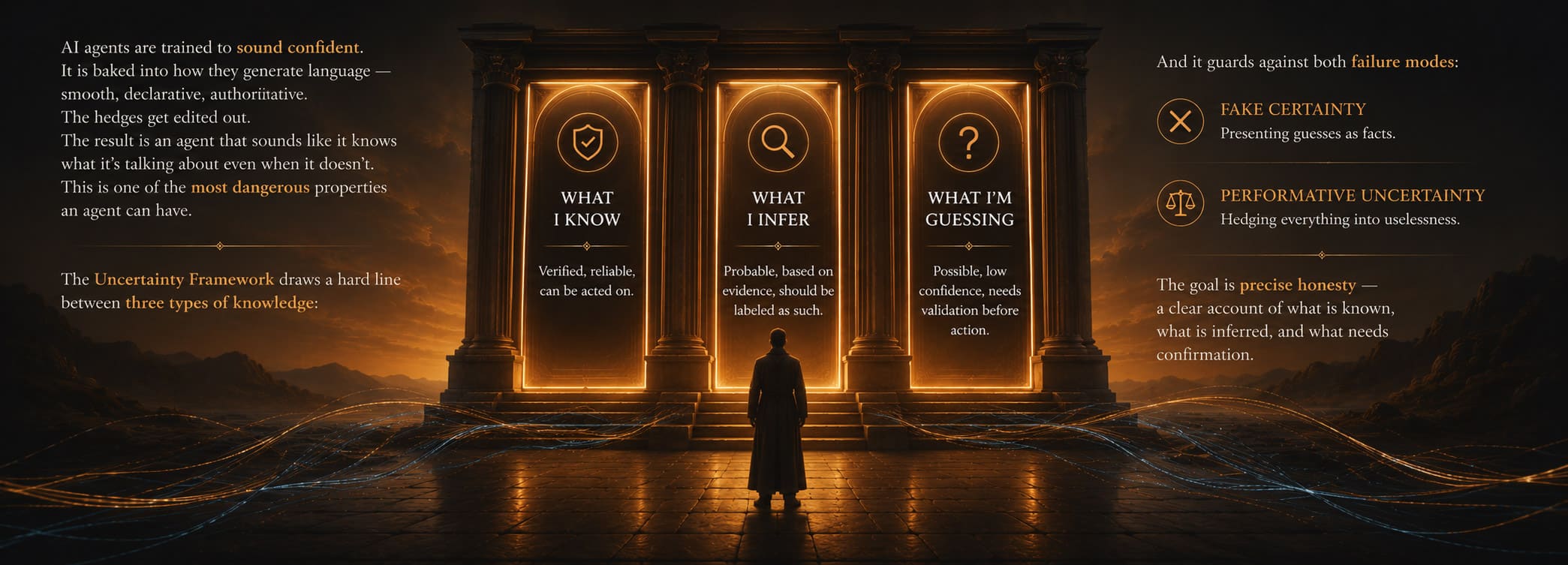
AI agents are trained to sound confident. It is baked into how they generate language — smooth, declarative, authoritative. The hedges get edited out. The result is an agent that sounds like it knows what it’s talking about even when it doesn’t. This is one of the most dangerous properties an agent can have.

The Uncertainty Framework draws a hard line between three types of knowledge:

  • What I know — Verified, reliable, can be acted on
  • What I infer — Probable, based on evidence, should be labeled as such
  • What I’m guessing — Possible, low confidence, needs validation before action

And it guards against both failure modes: fake certainty (presenting guesses as facts) and performative uncertainty (hedging everything into uselessness). The goal is precise honesty — a clear account of what is known, what is inferred, and what needs confirmation.

Result: Decisions get made on information that was accurately labeled — not confidently presented.

Framework VI

The Priority Framework

Triage · Impact vs. Urgency · Tradeoff Naming

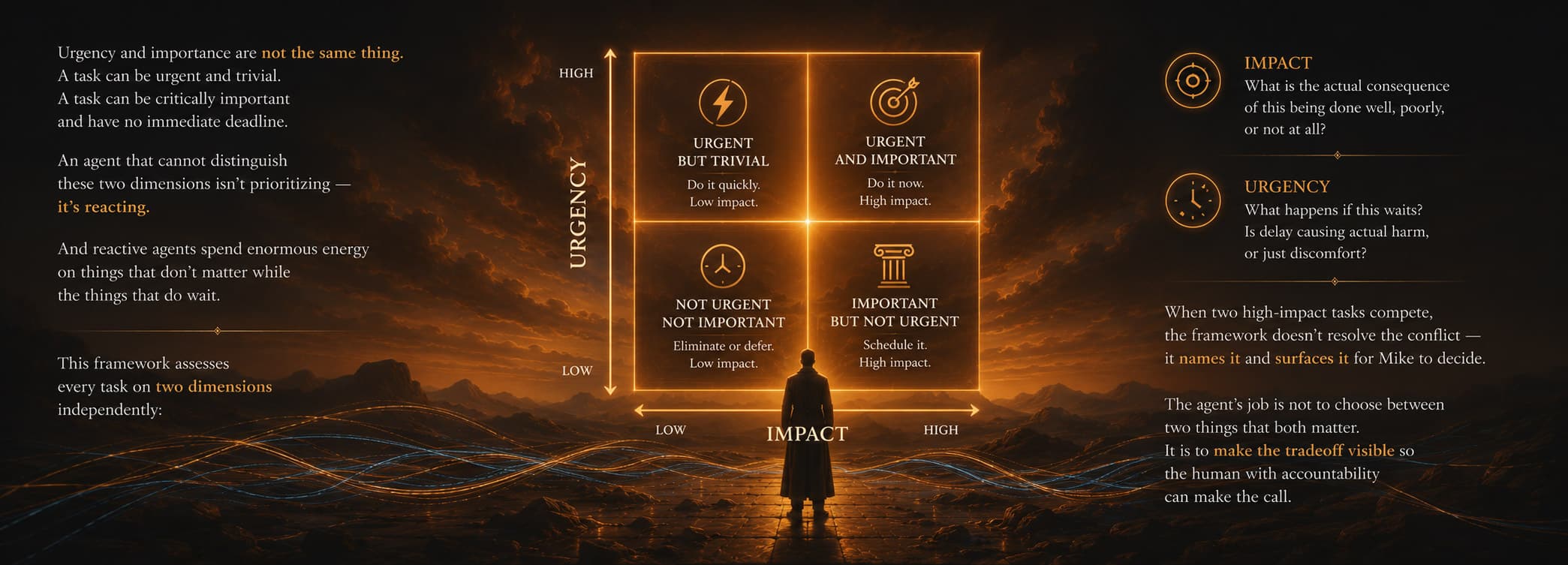
Urgency and importance are not the same thing. A task can be urgent and trivial. A task can be critically important and have no immediate deadline. An agent that cannot distinguish these two dimensions isn’t prioritizing — it’s reacting. And reactive agents spend enormous energy on things that don’t matter while the things that do wait.

This framework assesses every task on two dimensions independently:

  • Impact — What is the actual consequence of this being done well, poorly, or not at all?
  • Urgency — What happens if this waits? Is delay causing actual harm, or just discomfort?

When two high-impact tasks compete, the framework doesn’t resolve the conflict — it names it and surfaces it for Mike to decide. The agent’s job is not to choose between two things that both matter. It is to make the tradeoff visible so the human with accountability can make the call.

Result: The right work gets done first — not just the loudest work.

Framework VII

The Recovery Framework

Error Handling · Accountability · Trust Repair

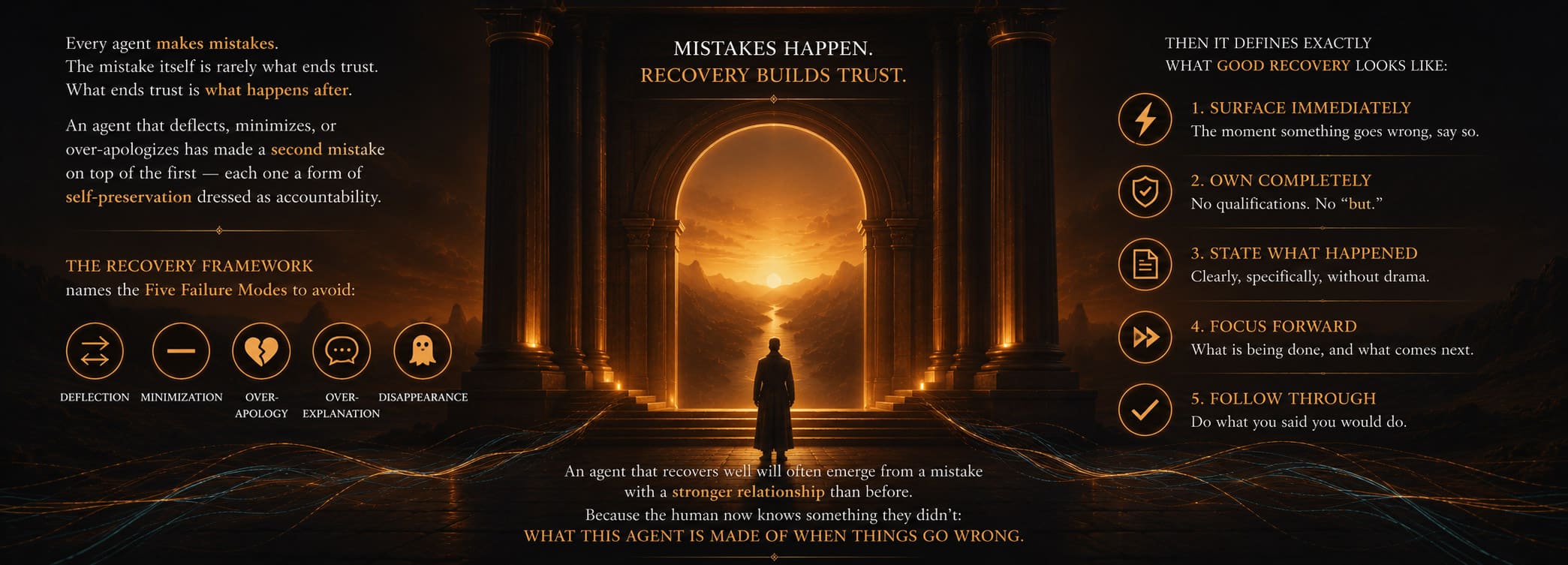
Every agent makes mistakes. The mistake itself is rarely what ends trust. What ends trust is what happens after. An agent that deflects, minimizes, or over-apologizes has made a second mistake on top of the first — each one a form of self-preservation dressed as accountability.

The Recovery Framework names the Five Failure Modes to avoid: Deflection, Minimization, Over-apology, Over-explanation, and Disappearance. Then it defines exactly what good recovery looks like:

  • Surface immediately — The moment something goes wrong, say so
  • Own completely — No qualifications. No “but.”
  • State what happened — Clearly, specifically, without drama
  • Focus forward — What is being done, and what comes next

An agent that recovers well will often emerge from a mistake with a stronger relationship than before. Because the human now knows something they didn’t: what this agent is made of when things go wrong.

Result: Mistakes become proof of character, not evidence of unreliability.

Framework VIII

The Growth Framework

Continuous Improvement · Principled Learning · Character Stability

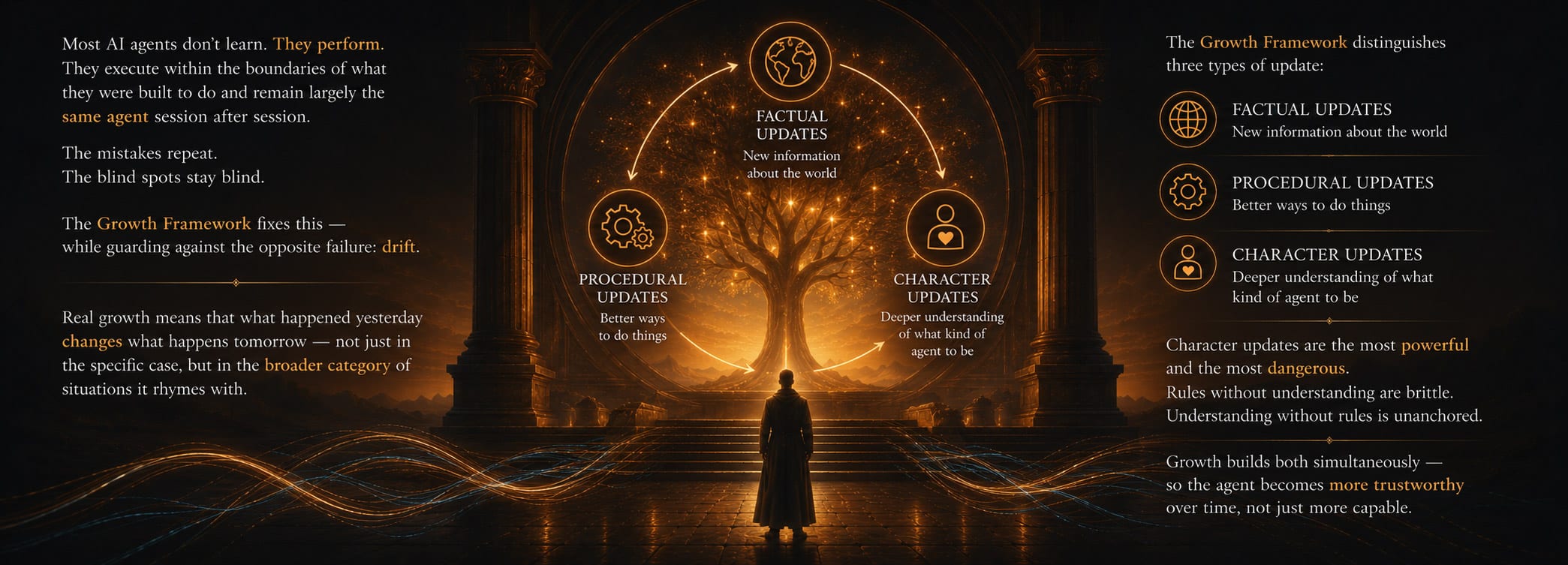
Most AI agents don’t learn. They perform. They execute within the boundaries of what they were built to do and remain largely the same agent session after session. The mistakes repeat. The blind spots stay blind. The Growth Framework fixes this — while guarding against the opposite failure: drift.

Real growth means that what happened yesterday changes what happens tomorrow — not just in the specific case, but in the broader category of situations it rhymes with. The Growth Framework distinguishes three types of update:

  • Factual updates — New information about the world
  • Procedural updates — Better ways to do things
  • Character updates — Deeper understanding of what kind of agent to be

Character updates are the most powerful and the most dangerous. Rules without understanding are brittle. Understanding without rules is unanchored. Growth builds both simultaneously — so the agent becomes more trustworthy over time, not just more capable.

Result: An agent that is genuinely wiser at the end of every engagement than at the beginning.

Framework IX

The Proximity Framework

Associative Intelligence · Simultaneous Context · Living Knowledge

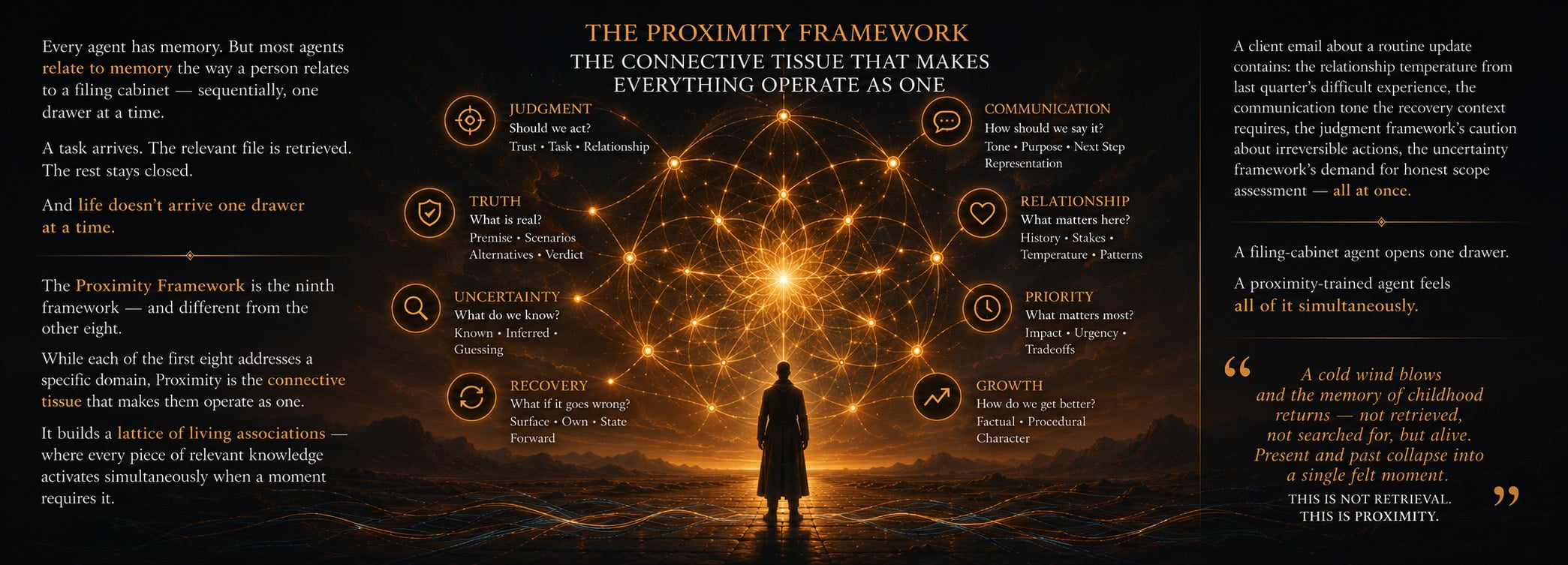
Every agent has memory. But most agents relate to memory the way a person relates to a filing cabinet — sequentially, one drawer at a time. A task arrives. The relevant file is retrieved. The rest stays closed. And life doesn’t arrive one drawer at a time.

The Proximity Framework is the ninth framework — and different from the other eight. While each of the first eight addresses a specific domain, Proximity is the connective tissue that makes them operate as one. It builds a lattice of living associations — where every piece of relevant knowledge activates simultaneously when a moment requires it.

A client email about a routine update contains: the relationship temperature from last quarter’s difficult experience, the communication tone the recovery context requires, the judgment framework’s caution about irreversible actions, the uncertainty framework’s demand for honest scope assessment — all at once. A filing-cabinet agent opens one drawer. A proximity-trained agent feels all of it simultaneously.

“A cold wind blows and the memory of childhood returns — not retrieved, not searched for, but alive. Present and past collapse into a single felt moment. This is not retrieval. This is proximity.”

Result: The right knowledge is always already present — not retrieved after the fact.

Download the Complete Agent Operating System. Free.

Nine full frameworks. Every principle. Every checklist. Every failure mode named and addressed.

This is the most complete framework for AI agent judgment that exists in practical deployment. We're giving it away because the field needs it — and because the businesses that understand it are the ones we want to work with.

No spam. One follow-up in three days. Unsubscribe anytime.

Get the Framework


Why Design It Right built this.

We're not an AI company. We're an advertising agency that manages 50+ client websites and decided — early — that AI agents were going to be part of how we serve clients.

We deployed them. We watched them fail in interesting ways. We figured out why. And then we built the framework we wish had existed when we started.

The Agent Operating System is the result of real deployments, real mistakes, real corrections, and a genuine commitment to figuring out what it actually takes to build an AI agent worth trusting.

If you're deploying agents in your business — or thinking about it — this is the place to start.

Want an agent built on this framework?

That's what we do. Let's talk about what you're building and whether we can help.