Local SEO for New Mexico Small Businesses: The Complete 2026 Guide
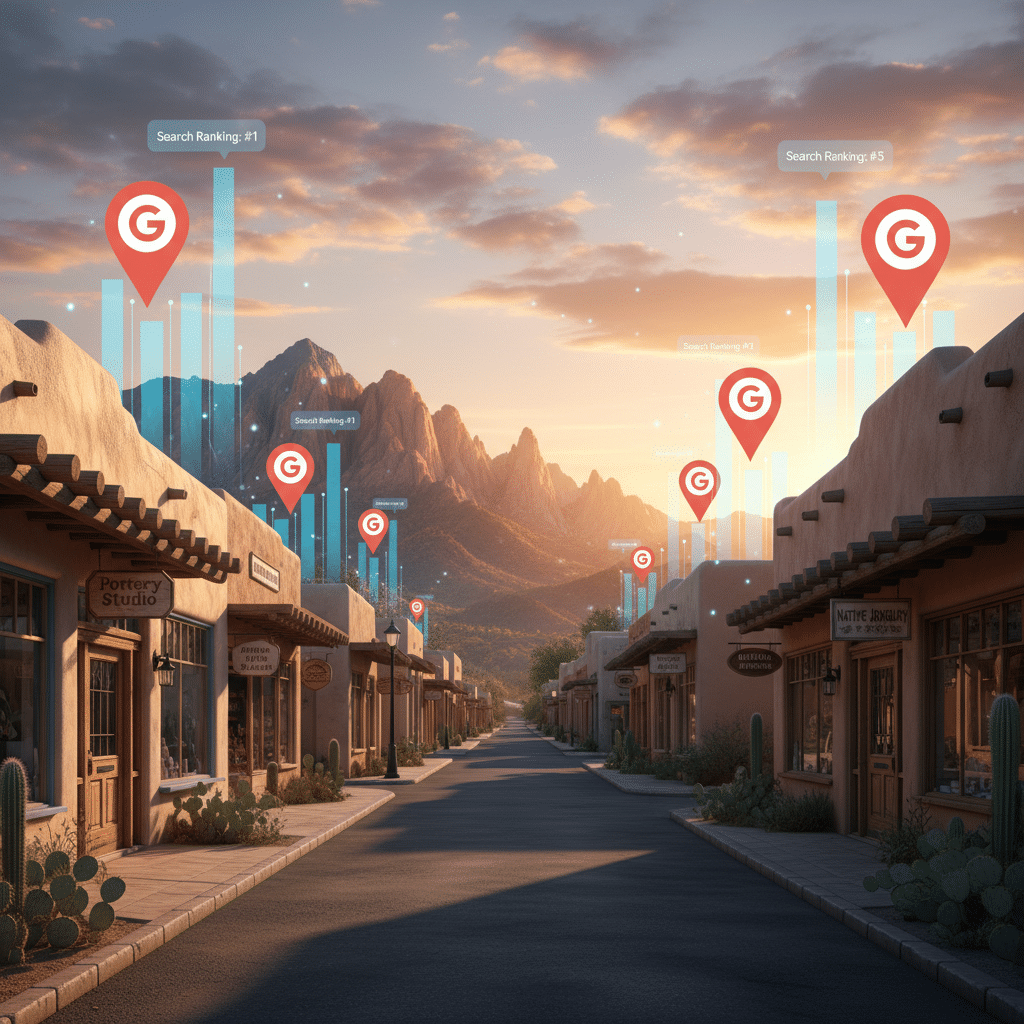
Ranking locally in New Mexico is not the same as ranking locally in Dallas or Chicago. The market is smaller, the competition is different, and the customer behaviors — shaped by a mix of urban Albuquerque, the sprawl of Rio Rancho, the arts economy of Santa Fe, and dozens of smaller communities — don’t follow national patterns neatly.
This guide is written for New Mexico business owners who want to understand local SEO in their actual market, not a generic playbook built for cities three times the size. Bluntly: most national SEO advice is built for markets where you’re competing with 50 similar businesses. In Albuquerque or Santa Fe, you’re often competing with 8. The strategy is fundamentally different.
What Local SEO Actually Is
According to the BrightLocal Local Consumer Review Survey, 98% of consumers used the internet to find a local business in 2023 — making local search visibility a baseline requirement, not a competitive advantage. Local SEO is the practice of making your business visible when someone nearby searches for what you offer. That means showing up in two places: the Google Map Pack and the organic results below it.
The Map Pack is the block of three business listings — with the map — that appears at the top of Google results for local searches. Below it are the organic results: standard blue-link rankings. Both placements drive real traffic, both require different strategies, and neither happens automatically just because you have a website.
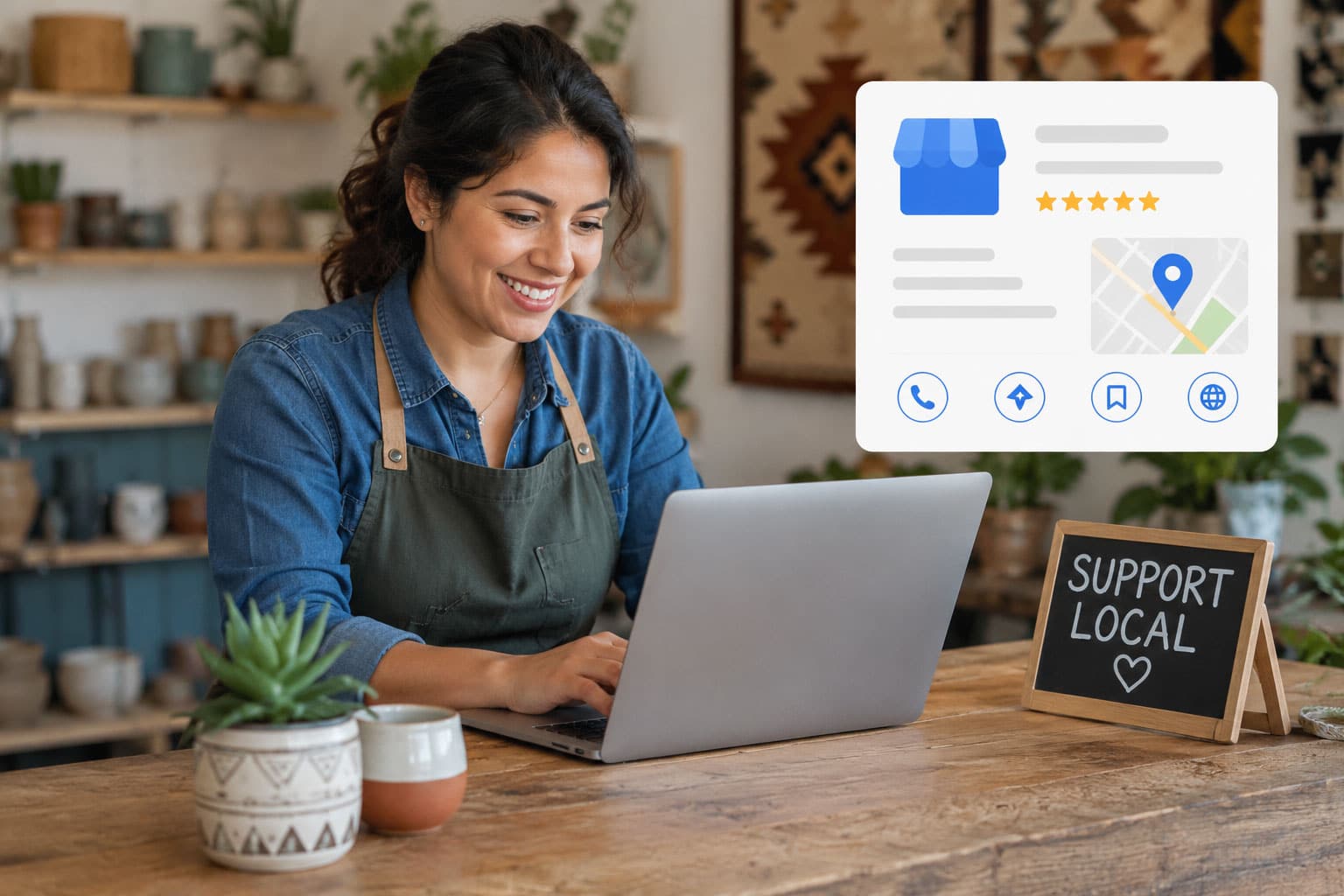
The Map Pack vs. Organic Results
Why Both Placements Matter for New Mexico Businesses
Both matter. Both require different strategies. And neither happens automatically just because you have a website.
The foundation of local SEO is this: Google needs to trust that your business is real, located where you say it is, and relevant to the search being made. Everything you do in local SEO is either building or reinforcing that trust.
Step 1: Claim and Fully Optimize Your Google Business Profile
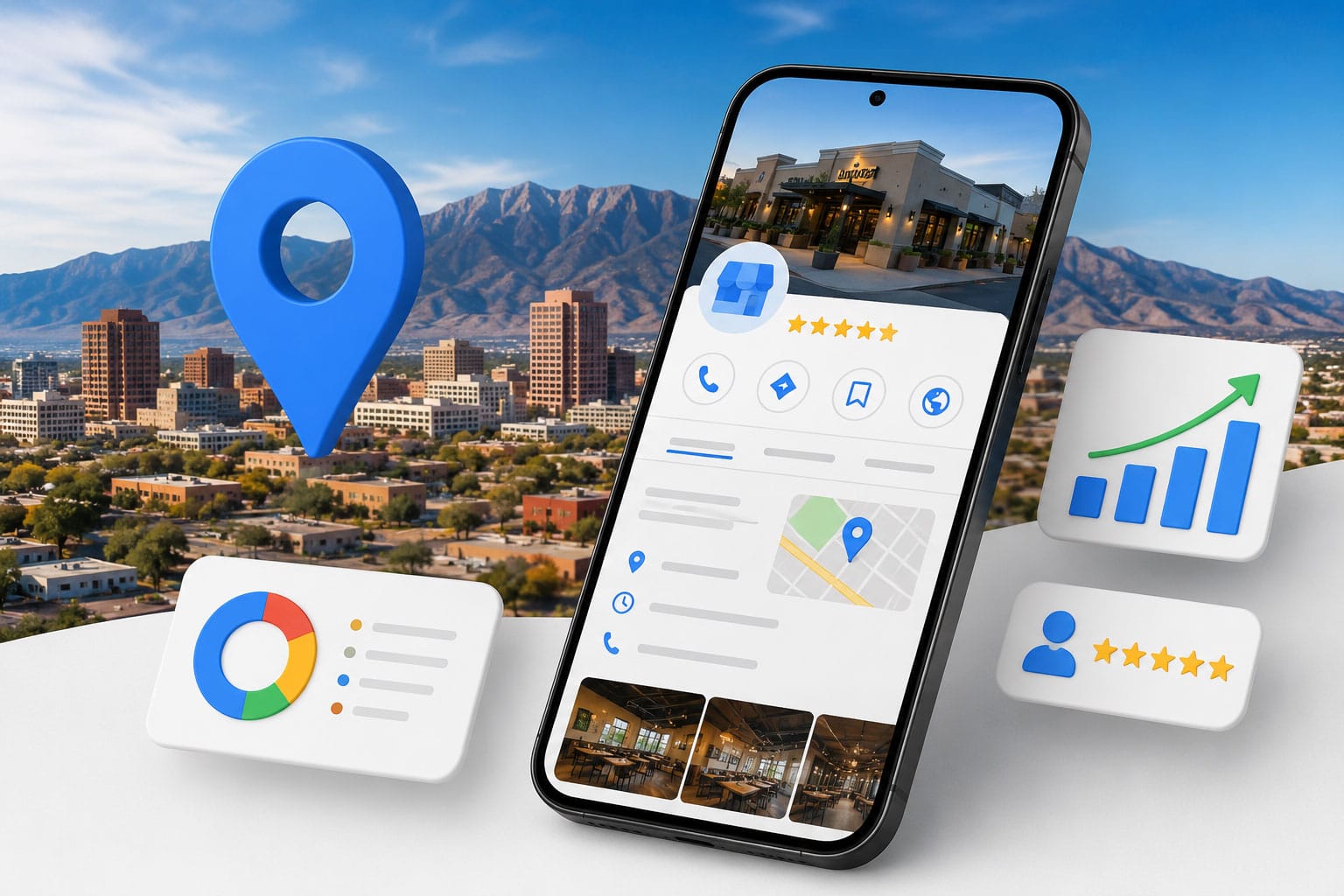
Your Google Business Profile (GBP) is the single highest-leverage asset in local SEO. BrightLocal data consistently places GBP signals as accounting for 36% of local ranking factors — more than any other single element.
A fully optimized GBP for a New Mexico business includes: Complete business information. Name, address, phone number, website, hours — all filled in, all accurate, and all matching exactly what appears on your website and every directory listing.
The most specific primary category possible. “Marketing Agency” is less specific than “Digital Marketing Agency.” “Restaurant” is less specific than “New Mexican Restaurant.” Google rewards specificity.
Photos: The Most Overlooked Ranking Signal
Photos — real ones, updated regularly. Google’s own data shows that businesses with photos receive 42% more requests for directions and 35% more clicks to websites. Stock photos don’t count. Real photos of your team, your space, and your work do.
Google Posts. These are short updates that appear in your GBP listing. One post per week — a promotion, an event, a tip, a recent project — signals active management to Google and gives searchers a reason to engage.
Q&A section. Seed it yourself. Ask and answer three to five common customer questions. This controls the narrative and adds keyword-rich content to your profile.
Step 2: Lock Down NAP Consistency Across New Mexico
NAP consistency — matching Name, Address, and Phone number across every directory and platform — is the foundational citation work that Google uses to verify your business’s legitimacy and location. In New Mexico, this matters because many local businesses have operated under multiple phone numbers, moved locations, or changed business names over the years, leaving a trail of inconsistent data that quietly suppresses local rankings.
The fix is methodical rather than complex: audit every major directory where your business appears — Google, Yelp, Bing Places, Apple Maps, BBB, and industry-specific directories — and update any listing where your NAP does not exactly match your Google Business Profile. Prioritize the directories with the highest domain authority first, then work toward complete consistency across all of them.
The Core Directories That Matter in New Mexico
Directories
NAP stands for Name, Address, Phone. Every place your business appears online — Google, Yelp, Bing, Apple Maps, Facebook, BBB, the Albuquerque Chamber of Commerce, the New Mexico Secretary of State business listing — needs to show the exact same information.
Not close. Exact.
“Suite 200” and “Ste. 200” are different. “(505) 596-0886” and “505-596-0886” are different to directory aggregators. These inconsistencies create conflicting signals that weaken your local ranking.
- Albuquerque Chamber of Commerce
- New Mexico Business Coalition
- Santa Fe Chamber of Commerce (if you serve that market)
- NM Department of Commerce business directory
- Yelp Albuquerque category listings
- Better Business Bureau New Mexico
Step 3: Build Location-Specific Pages for Every Market You Serve
New Mexico-specific directories worth claiming: Fix the data aggregators — Data Axle, Localeze, and Foursquare — and the corrections push downstream to dozens of secondary directories automatically. If your business serves multiple New Mexico communities, a single “Albuquerque” page isn’t enough. Create dedicated pages for each city or region you actively serve: Rio Rancho, Santa Fe, Las Cruces, Farmington, Roswell. Each page should be substantively different — with specific content about that community, its business environment, and why your service fits their needs.
Thin location pages (same copy, different city name swapped in) do not work. Google identifies them as duplicate content. Write real, locally relevant content for each location, and you’ll earn rankings in markets your competitors aren’t even targeting.
Step 4: Build Your Review Strategy — Systematically
For an Albuquerque-based business, the high-value secondary markets are often Rio Rancho (fastest-growing city in NM), Santa Fe (strong arts and hospitality economy), and Bernalillo/Corrales (growing residential and small business base). Reviews account for approximately 17% of local ranking factors. More importantly, they’re often the deciding factor when a customer is choosing between two businesses with similar visibility.
The businesses that dominate local search in Albuquerque aren’t always the ones with the best reviews. They’re the ones with the most consistent review acquisition strategy. What works: Ask at the moment of highest satisfaction. Right after a project is complete, right after a positive service experience — that’s the window. A text message with a direct Google review link converts far better than an email a week later.
Make it frictionless. Create a short URL that takes customers directly to your Google review form. Put it on your invoices, your receipts, your follow-up texts.
Responding to Reviews: The Signal Businesses Miss
Respond to every review. Every five-star, every three-star, every complaint. Response rate signals active management to Google and signals genuine care to potential customers reading reviews.
Never buy reviews. Google’s review spam detection has become significantly more sophisticated. Fake reviews get flagged, removed, and can result in GBP suspension.
Step 5: Publish Local Content Consistently
Google rewards websites that publish fresh, locally relevant content — consistently, not in bursts. For a New Mexico small business, local content means articles that address your customers’ real questions within the context of this specific market. Not generic industry posts. Not content that could have been written for a business in Ohio.
- “Best [service] in Albuquerque” guides
- Neighborhood-specific content (Nob Hill, Old Town, the Heights, Corrales)
- Content addressing local seasonality (monsoon season impact on [industry], balloon fiesta season for hospitality)
- Local business spotlights and community involvement
- Content addressing the unique challenges of operating in NM (altitude, climate, bilingual market)
Topics that perform well for local SEO in New Mexico: One quality post per month, consistently, outperforms a content burst followed by six months of silence. Google tracks publication cadence.
Step 6: Build Local Backlinks
Local backlinks — links to your site from other reputable Albuquerque or New Mexico websites — are one of the strongest signals Google uses to determine local authority. A link from the Albuquerque Journal, the Greater Albuquerque Chamber of Commerce, or a local industry association carries more weight for your local rankings than dozens of generic directory links. The goal is relevance and authority, not volume.
The most practical backlink building strategies for New Mexico small businesses are: getting listed on local business association directories, earning coverage in local media by pitching genuinely newsworthy stories, sponsoring local events that publish sponsor pages online, and building reciprocal relationships with complementary local businesses. Each of these produces a link with local relevance — the kind that moves Map Pack and organic rankings in ways that national link building strategies rarely replicate at a local level.
- Sponsor a local event and get listed on the event website
- Submit a guest article to an Albuquerque Journal business blog or local industry publication
- Partner with complementary local businesses for cross-referral and co-content
- Get listed in industry associations with New Mexico chapters
- Participate in Albuquerque Business First features, press releases, and “Best of” lists
Step 7: Add Schema Markup to Your Website
Backlinks from other New Mexico websites — local news outlets, chambers of commerce, community organizations, local blogs — carry disproportionate weight in local search rankings. How to build them in the New Mexico market: One quality local backlink is worth more than ten generic directory submissions. Schema markup is code that tells Google explicitly what your business is, where it’s located, what it does, and how to contact you. It’s the difference between Google inferring your business type and Google knowing it.
- LocalBusiness schema with name, address, phone, URL, and business hours
- Service schema for each service you offer
- Review schema if you display testimonials on your site
- FAQ schema on any page with questions and answers
For a New Mexico small business, the minimum schema implementation includes: Schema doesn’t directly boost rankings. It improves how Google presents your business in search results — which directly improves click-through rate, which directly affects rankings.
The New Mexico Market: What’s Different
New Mexico’s search market has characteristics that distinguish it from other regional markets. The population is distributed across a large geographic area with meaningful differences between Albuquerque, Santa Fe, Las Cruces, and rural communities — which means local SEO strategy needs to account for which specific cities and towns your business actually serves, not just the state as a whole.
The market also has a higher-than-average percentage of searches on mobile devices and a consumer culture with strong preferences for locally owned businesses over national chains in many categories. Content and messaging that acknowledges New Mexico’s geography, culture, and community identity consistently performs better than generic content that could apply to any market. That specificity is a competitive advantage that national competitors cannot easily replicate.
Bilingual and Cultural Considerations in Local Search
A few things worth knowing about local SEO in this specific market: Bilingual search matters. New Mexico has a significant Spanish-speaking population. If your customer base includes Spanish-speaking residents, Spanish-language keyword optimization and bilingual GBP content can open a segment your competitors aren’t touching.
Albuquerque vs. Santa Fe vs. Rio Rancho
The market is relationship-driven. New Mexico business culture — particularly in Albuquerque — values local relationships highly. Content and marketing that signals genuine community connection outperforms generic corporate messaging here in ways that don’t always translate in larger markets.
Competition is lower than you think. Albuquerque is not Austin. The local SEO competition for most service industries is far less intense than in coastal markets, which means the threshold to rank is lower ??? and the businesses that make the effort consistently are the ones that dominate for years.
What to Do This Week
The highest-leverage actions you can take this week to improve your local SEO in New Mexico require no budget and produce measurable results within 30 to 90 days. Start with your Google Business Profile: verify it is fully completed, add current photos, and confirm your NAP matches your website exactly. Then request reviews from your five most satisfied recent customers using a direct link to your Google review page.
Next, open Google Search Console and confirm your sitemap is submitted and your site has no coverage errors. If you have not claimed your Bing Places and Apple Maps listings, do that now — both are quick wins that cost nothing and contribute to your overall citation profile. These four actions, completed consistently, form the foundation that everything else in a local SEO strategy builds on.
-
How to Audit Your Existing Citations
Local SEO is a long game. But these actions produce meaningful movement within 30–60 days: Audit your Google Business Profile. Fill in every empty field.
- Check NAP consistency across Google, Yelp, Bing, and Facebook. Fix any discrepancies.
- Send a review request to your last 10 satisfied customers.
- Publish one locally-relevant article on your website.
- Claim any unclaimed directory listings for your business in New Mexico.
Small consistent actions, executed every week, compound into market dominance over 6–12 months.
Need help building a local SEO strategy for your New Mexico business? Let’s talk. →
*Design It Right is an Albuquerque-based digital marketing agency specializing in local SEO for New Mexico small businesses. We’ve been helping local businesses get found since 1992. Call (505) 596-0886.*
Frequently Asked Questions
About the Author: Mike Jennings is one of the founders and lead developer at Design It Right, a national digital marketing agency. With over 30 years of experience building websites and growing businesses online, Mike has worked with clients across New Mexico, Texas, California, and beyond. Questions? Reach him at [email protected].