
Website Redesign Cost for Albuquerque Small Businesses: What to Expect in 2026

The most common question we get before a new project starts: “What’s this going to cost?” And our honest answer is always the same: it depends on what you’re actually trying to accomplish — not how many pages you want.
It’s a fair question. The range of answers — from $500 to $50,000+ — makes it nearly impossible to budget without context. This guide gives you that context, specific to Albuquerque, specific to small businesses, and honest about what the numbers actually mean.
The Real Price Range for a Small Business Website Redesign
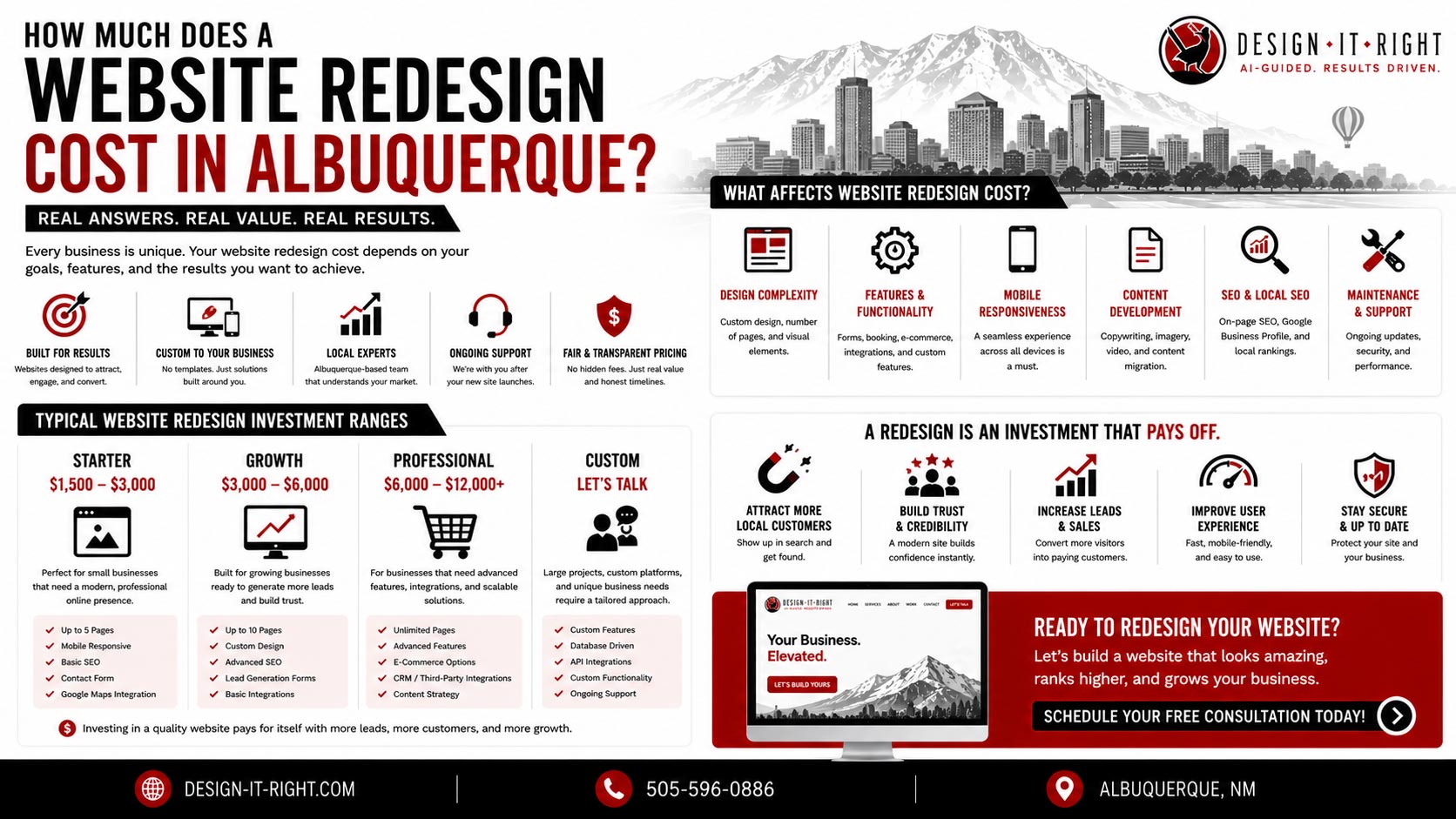
Here’s what you can expect to pay at different levels of service in Albuquerque’s market: The ranges above reflect real Albuquerque market rates — not national averages that ignore the size of your actual local market. What separates the tiers isn’t just the dollar amount. It’s the depth of strategy, the quality of discovery, and whether the person building your site has built one for a business like yours before.
About the Author: Mike Jennings is one of the founders and lead developer at Design It Right, a national digital marketing agency. With over 30 years of experience building websites and growing businesses online, Mike has worked with clients across New Mexico, Texas, California, and beyond. Questions? Reach him at [email protected].
Here’s what you can expect to pay at different levels of service in Albuquerque’s market:
| Project Type | Typical Range | What You’re Getting |
|---|---|---|
| Template-based freelancer | $800 – $2,500 | Basic design, minimal customization, no SEO strategy |
| Small local agency | $3,000 – $7,000 | Custom design, WordPress build, basic SEO setup |
| Full-service agency | $7,000 – $15,000 | Custom design, SEO architecture, content strategy, integrations |
| Enterprise / custom build | $15,000 – $50,000+ | Complex functionality, e-commerce, custom development |
Most Albuquerque small businesses fall in the $3,000–$10,000 range for a legitimate redesign that includes strategy, not just aesthetics.
The key word is “legitimate.” A $1,200 website that doesn’t rank, loads slowly on mobile, and breaks the first time a plugin updates is not a bargain. It’s a downpayment on a more expensive rebuild.
What Actually Drives the Cost Up
The three factors that most reliably push website redesign costs above initial estimates are custom functionality, content migration complexity, and scope changes during the build. Custom functionality — booking systems, membership portals, complex filtering, custom calculators — requires development time that is not included in a standard redesign package and needs to be scoped and priced explicitly before work begins.
Content migration is the most frequently underestimated cost driver. Moving hundreds of pages, images, and documents from an old site to a new one while preserving SEO value requires careful planning and execution. Businesses with large existing content libraries or complex URL structures should ask specifically about content migration strategy and cost before signing any redesign agreement.
Understanding what moves the needle on price helps you evaluate quotes more accurately.
Functionality, Integrations, and Custom Development
Number of pages. A 5-page brochure site is fundamentally different from a 40-page service site with location pages, blog archives, and a portfolio. Every page that needs custom design, original content, and SEO setup adds time and cost.
Content creation. This is the variable most business owners underestimate. A website without strategic content — written for the right keywords, structured for search intent, and compelling enough to convert — is a digital brochure. Content strategy can add $1,500–$4,000 to a project, but it’s usually the single most important investment you make.
Custom functionality. Contact forms and image galleries are standard. Booking systems, membership portals, e-commerce, and API integrations require custom development work that adds both time and cost.
SEO architecture. Schema markup, internal linking strategy, Google Search Console setup, Yoast configuration, and sitemap submission are not automatic. Ask specifically whether these are included in any quote you receive.
Design complexity. A clean, conversion-focused layout built on a proven framework (like Avada on WordPress) costs less to build and maintain than a fully bespoke design. Not because it’s cheaper — because it’s smarter.
What a Website Redesign Should Always Include
Regardless of budget, a professional website redesign should always include mobile responsiveness across all page types, Core Web Vitals optimization to meet Google’s performance thresholds, proper redirect mapping for any changed URLs to protect existing search rankings, and a clear conversion path on every major landing page. These are not premium add-ons — they are the baseline for a site that performs.
SEO foundation work should also be non-negotiable: proper heading hierarchy, optimized meta titles and descriptions, compressed images with descriptive alt text, and a sitemap submitted to Google Search Console. A redesigned site that loses its existing search rankings because these fundamentals were skipped is not an improvement — it is an expensive setback that can take six to twelve months to recover from.
Regardless of budget level, certain things should never be optional.
Technical Foundation: Speed, Security, and Mobile
Mobile-first design. More than 60% of searches happen on mobile. A site that isn’t built mobile-first isn’t built right.
SSL certificate. HTTPS is a Google ranking factor and a basic trust signal. If it’s not included, the agency is cutting corners you can’t afford.
Speed optimization. Uncompressed images, bloated code, and no caching strategy produce slow sites. Slow sites lose rankings and lose customers. Ask what the expected PageSpeed score is after launch.
SEO Architecture Built In From Day One
Basic on-page SEO. Meta titles, meta descriptions, H1 structure, image alt text, and XML sitemap submission. These are not extras. They are the minimum for a site that has any chance of being found.
Domain and hosting ownership. You should own your domain. You should control your hosting account. Any agency that holds these on your behalf — without a clear exit plan — creates a dependency you’ll regret.
What’s Never Worth Paying For
Some line items show up on quotes that add cost without adding value.
The agencies that won’t show you a line-itemized quote before you sign have something to hide. Scope creep isn’t an accident — it’s often a business model.
Proprietary CMS. If the agency builds your site on a platform you can only access through them, you’re locked in. WordPress is the standard for a reason — it’s portable, widely understood, and not owned by any single vendor.
“SEO packages” with no defined deliverables. Vague monthly retainers that promise “optimization” without specifying what will be done, measured, and reported are a red flag.
Stock photo libraries presented as original design. Your competitors use the same stock photos. Authentic imagery — real team photos, real workspace photos, real project photos — consistently outperforms generic imagery on conversion rates.
Annual contracts for things that should be month-to-month. Maintenance and hosting should have clear monthly pricing with no long-term lock-in. The agency confident in their work doesn’t need to hold you captive.
The Real Cost of Not Redesigning
This is the question most business owners don’t think to ask.
If your current site isn’t ranking for your core keywords, isn’t converting the traffic it does get, and isn’t functioning correctly on mobile — what is that costing you every month in missed leads?
A local service business that misses 10 qualified leads per month at a $500 average job value is leaving $60,000 per year on the table. Against that number, a $7,500 redesign looks like exactly what it is: a low-risk, high-return investment.
How AI Is Changing Website Redesign Economics
One development worth understanding: AI-assisted web design is compressing timelines and improving quality simultaneously.
Design It Right uses AI agents to handle research, content drafts, technical audits, and performance monitoring — tasks that previously required hours of manual work per site. This means we can deliver more thorough, more strategic work in less time than a traditional agency model allows.
For clients, this translates to faster turnarounds, more comprehensive SEO setup, and ongoing monitoring that flags issues before they become expensive problems.
It also means we’re not billing you for hours a machine can handle.
How to Evaluate a Website Redesign Quote
When you receive a proposal, here’s the checklist worth running through:
- Does it specify the number of pages included?
- Is content creation included or quoted separately?
- Does it include on-page SEO setup (not just “SEO-friendly”)?
- What is the post-launch support structure?
- Who owns the domain, hosting, and CMS after the project?
- What does the maintenance plan cost?
- Can you see comparable local projects they’ve completed?
A quote that can’t answer all of these clearly is a quote that’s hiding something.
What Design It Right Includes (and Doesn’t Hide)
We build on WordPress with Avada — a proven, flexible framework we’ve been using for over a decade. Every project includes mobile optimization, speed optimization, on-page SEO setup, and a clear handover of all credentials.
We write content for clients who need it. We don’t pretend content strategy is optional.
We don’t lock clients into proprietary systems, long-term hosting contracts they can’t exit, or monthly retainers without defined deliverables.
That’s what 30+ years of working with Albuquerque businesses taught us to do — and what it taught us to stop doing.
Get a transparent quote for your redesign →
*Design It Right is a full-service digital marketing agency based in Albuquerque, NM. We’ve been designing and building websites since 1992. Call (505) 596-0886 or email [email protected].*
Frequently Asked Questions
According to Google’s Core Web Vitals documentation, page speed and load performance are confirmed ranking signals — meaning a slow redesign can actively suppress your search visibility even after launch. Our honest answer when clients ask about redesign cost: it depends on what you’re actually trying to accomplish — not how many pages you want. A 5-page site that converts beats a 20-page site that confuses every time.